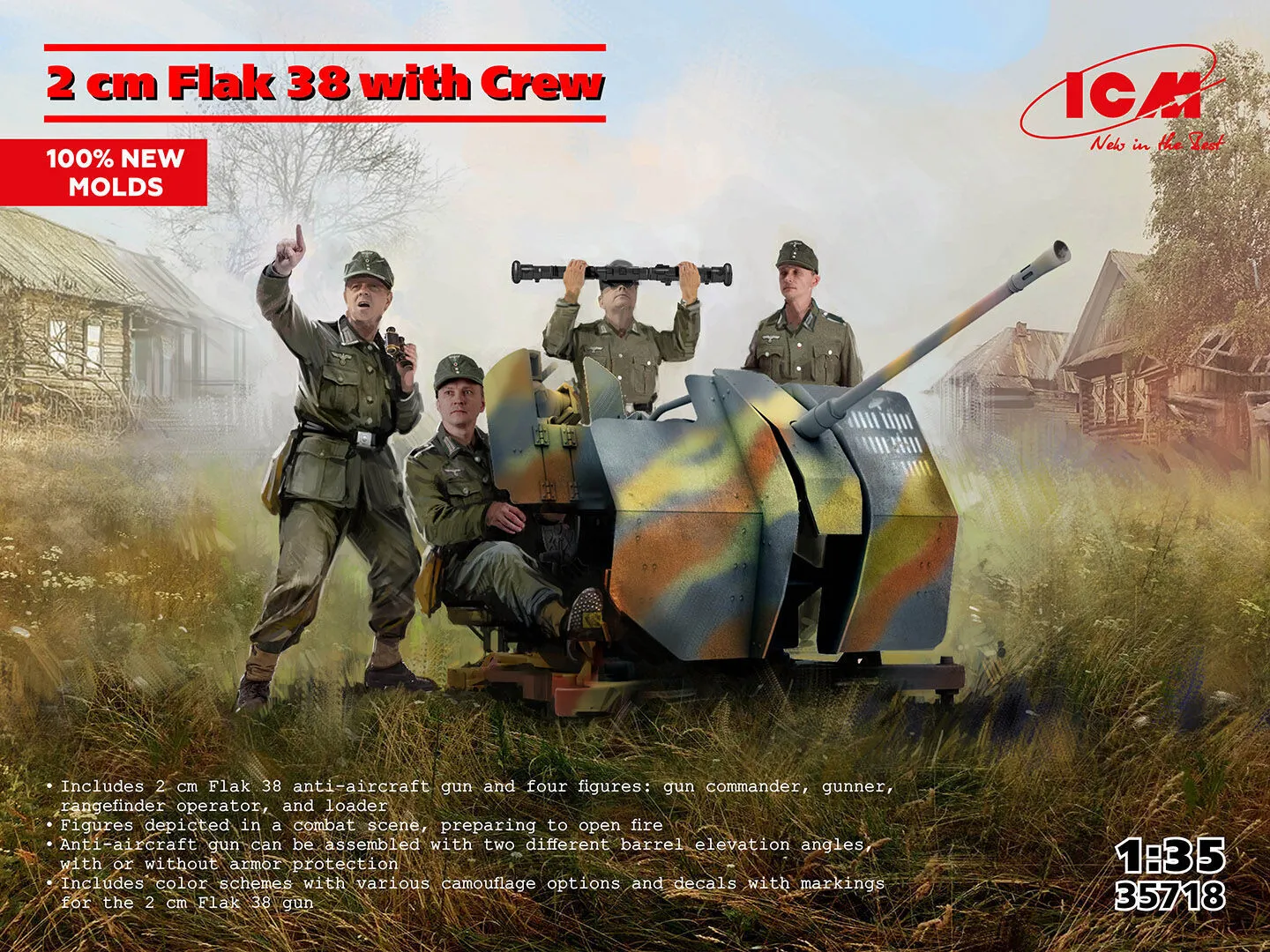
2 cm Flak 38 with Crew
At the beginning of World War II, the German Armys anti-aircraft defense relied on specialized motorized companies, each equipped with 12 automatic anti-aircraft guns. However, as the Luftwaffe lost air superiority, the need to protect units from enemy attack aircraft and fighter-bombers intensified. Many Wehrmacht combat formations began incorporating anti-aircraft units armed with heavy 88-mm guns, complemented by 20-mm automatic cannonsthe 2 cm Flak 38. The 2 cm Flak 38 anti-aircraft gun entered service in the second half of 1940, deployed to both Wehrmacht and Luftwaffe ground units. Over time, these small-caliber anti-aircraft guns grew in number, becoming the primary means of close-range air defense. By May 1944, the Wehrmachts ground forces boasted 6,355 single-barreled and 925 quadruple-barreled 20-mm guns. While the full combat crew for the 2 cm Flak 38 consisted of five personnel, combat conditions often saw four or even three soldiers effectively operating the gun and fulfilling various tasks.
The Flak 38 (2 cm FlaK 38) was a German anti-aircraft cannon widely used during World War II.
It was originally designed for mobile air defense against low-flying enemy aircraft, but it proved versatile enough to be adapted for various roles, including ground support and infantry defense.
Manufactured by Rheinmetall, the Flak 38 became one of the most effective light anti-aircraft weapons of its time. 1.
Design and Technical Specifications: Caliber: The Flak 38 was a 20 mm cannon, capable of firing high-velocity rounds at a rapid rate.
Rate of Fire: It could fire up to 450 rounds per minute, though the practical sustained rate was closer to 120-180 rounds per minute due to overheating and reloading pauses.
Range and Elevation: The cannon had an effective vertical range of about 2,200 meters (7,218 feet) against aerial targets and a horizontal range of around 5,000 meters.
It could be adjusted vertically from -12 to +90 degrees, allowing for a wide range of firing angles.
Mounting and Mobility: It was often mounted on a three-legged base or a wheeled carriage, making it relatively easy to deploy in various settings.
It could also be mounted on vehicles, notably the Sd.Kfz. 10/4 half-track, which gave it additional mobility on the battlefield. 2.
Operational Use: The Flak 38 was primarily designed to counter low-flying aircraft, particularly Allied fighters and bombers.
It used both explosive shells and armor-piercing rounds to maximize its impact on targets.
The gun was versatile enough for dual-purpose use, as it could also target ground vehicles, light armor, and infantry positions.
In its ground-support role, it provided German infantry with a reliable means of combating lightly armored vehicles.
It was used in fixed positions, as a portable field piece, and on various vehicles (like the Wirbelwind and Flakpanzer tanks) for increased mobility and battlefield flexibility. 3.
Variants and Adaptations: Quadruple Mount: The Flakvierling 38 was a variant that featured four linked 20 mm Flak 38 barrels.
This adaptation significantly increased the weapon’s rate of fire and ability to saturate the airspace with projectiles, making it particularly lethal against aircraft in close range.
Vehicle-Mounted Versions: The Flak 38 was frequently mounted on half-tracks, trucks, and specially adapted anti-aircraft tanks.
These adaptations allowed the weapon to move with armored and mechanized divisions, providing critical air defense in mobile warfare. 4.
Legacy and Historical Significance: The Flak 38 proved to be a critical asset in German air defense, helping counter the increasing Allied air superiority during the war.
Despite being gradually replaced by larger and more powerful anti-aircraft guns, the Flak 38’s versatility and effectiveness made it a staple of German anti-aircraft forces throughout the conflict.
After WWII, captured Flak 38s continued to see service in other countries, and today it remains an iconic piece of military hardware studied by his
Key Specifications
Full Specifications
| Plastic Kits | Land |
| PLASTIC MODELS | MILITARY VEHICLES |
| SKU | ICM35718 |
| Manufacturer | ICM |
| EAN | 4823044410651 |
| Short Description | ICM 1/35 Flak 38 with Crew # 35718 |